
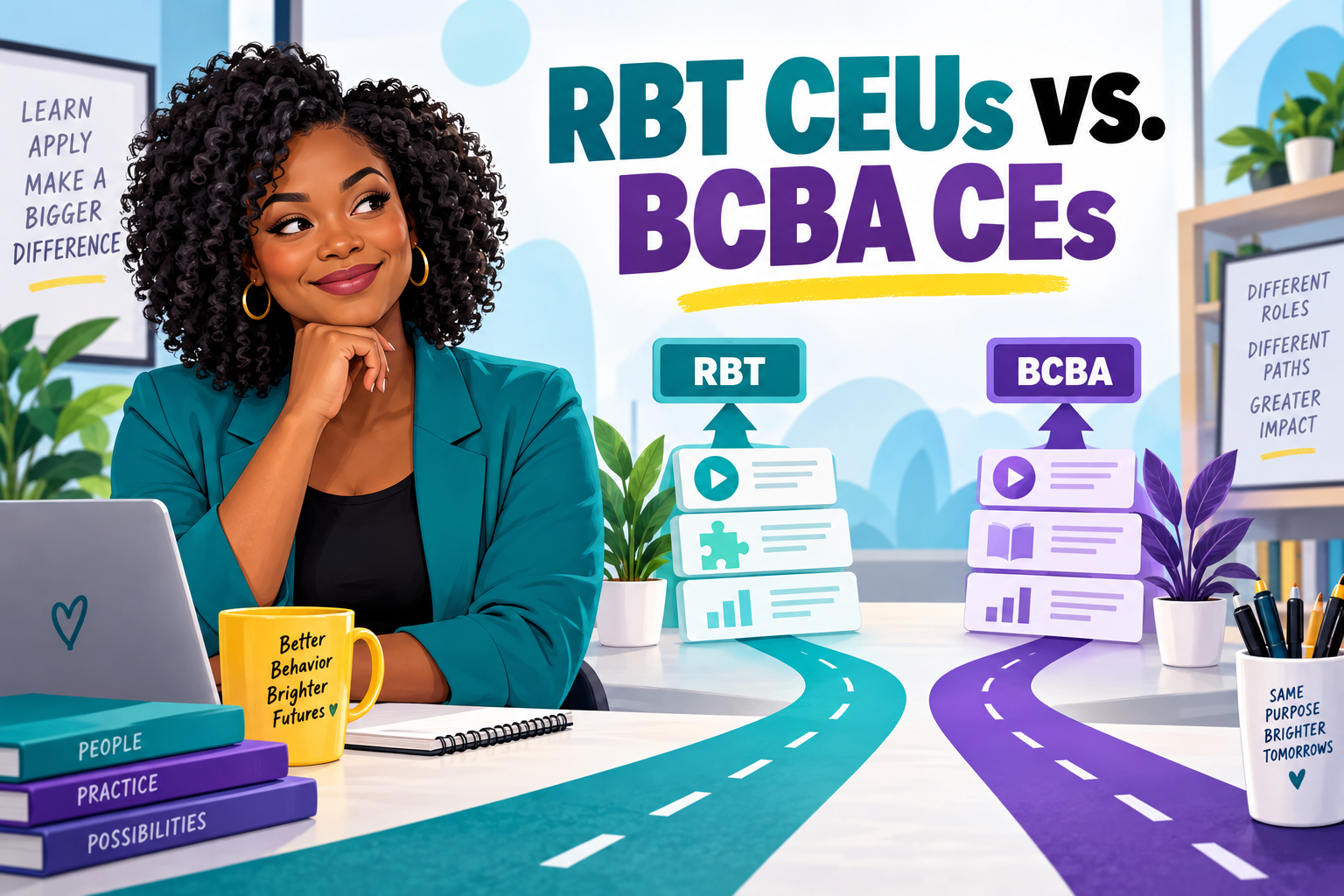
If you searched for RBT CEUs, you are not alone—and you are not wrong for being confused. The language around professional development changed in 2026, and “CE,” “CEU,” and “PDU” are often used as if they mean the same thing. They do not. Registered Behavior Technicians and Board Certified Behavior Analysts hold different credentials, perform different roles, and follow different renewal requirements.
Here is the short version: RBTs earn professional development units, or PDUs. BCBAs earn continuing education units, or CEUs. A training can be designed and approved for one audience, the other audience, or both—but completion for one credential does not automatically make it valid for the other.
Browse practical courses built for the people doing the direct work.
Explore RBT professional development →RBT CEUs are now called PDUs
People will keep searching “RBT CEUs” because that phrase feels familiar. The official BACB language for the 2026 RBT requirements, however, is professional development units. After an RBT becomes newly certified or recertifies in 2026, the RBT must complete 12 hours of PDUs during the two-year recertification cycle.
Those PDUs may come from didactic behavior-analytic university coursework, qualifying in-service training, or eligible professional-development events offered by an Authorized Continuing Education Provider. The BACB also makes an important timing distinction: an RBT cannot begin accumulating the new PDUs until after certifying or recertifying in 2026. Translation? Do not buy random training, assume it counts, and try to sort it out at renewal time.
RBT professional development should connect to the technician’s actual scope and day-to-day performance. That may include data collection, documentation, skill acquisition, ethics, communication, responding to feedback, de-escalation, professional boundaries, or other content appropriate for RBT practice. The point is not to turn technicians into mini-BCBAs. The point is to help technicians perform their own role with stronger judgment, consistency, and skill.
Always confirm current requirements in the BACB RBT Handbook and keep the documentation supplied by the training provider.
What BCBAs need is different
BCBAs maintain certification through continuing education units. Under the current BACB requirements, BCBAs complete 32 CEUs during each two-year recertification cycle, including required ethics content and supervision content when applicable. The exact category requirements may depend on the cycle and the requirements in effect for that certificant, so the BCBA Handbook remains the final source.
BCBA continuing education is designed for the responsibilities of an independent behavior analyst: assessment, interpretation, treatment design, clinical decision-making, supervision, ethics, research, and maintaining competence at the analyst level. That is not the same instructional target as professional development created for a technician who implements plans under supervision.
| Credential | What the BACB calls it | Two-year requirement | Primary focus |
|---|---|---|---|
| RBT® | PDUs | 12 hours after certifying or recertifying in 2026 | Technician-level practice and professional growth |
| BCBA® | CEUs | 32 units, with applicable categories | Analyst-level practice, ethics, supervision, and clinical competence |
Why the credits do not automatically cross-apply
The easiest way to understand this is to stop focusing on the number printed on a certificate and look at the intended audience, learning objectives, provider documentation, and credential rules. One hour of instruction may equal one unit in a provider’s system, but that does not make the content universally valid.
1. The audiences have different scopes
An RBT course should be designed around competent implementation, observation, communication, and performance under supervision. A BCBA CE event should extend the knowledge and decision-making of an independent practitioner. The same topic can appear in both spaces, but the depth, objectives, and expected application should differ.
2. The provider must designate the event correctly
An ACE Provider may offer programming for BCBAs, RBTs, or both when the event meets the applicable requirements. Providers should identify the audience and the type of unit offered. “Presented by a BCBA” is not enough. A webinar does not become BCBA CE just because a BCBA taught it, and a general staff meeting does not become an RBT PDU simply because behavior was discussed.
3. Documentation is credential-specific
The certificate or event documentation should clearly show what was earned. RBTs need documentation that supports the applicable PDU pathway. BCBAs need documentation that meets the continuing-education requirements for the category claimed. If the paperwork says the event is for RBT PD, do not relabel it as BCBA CE in your account.
The rule to remember: same topic does not mean same credit. Check the audience, the event designation, and the certificate before you count anything.
What should RBTs look for before enrolling?
Start with the course page. It should say who the training is for, what the learner will be able to do, how long the instruction lasts, and whether documentation is issued. Look for content that improves what happens in session—not vague motivation wearing a clinical nametag.
- Confirm the course is designated for RBT professional development.
- Check that the topic is appropriate for RBT practice.
- Verify the number of PDUs and how completion is measured.
- Save the certificate or official event form.
- Make sure the event falls inside your active recertification cycle.
- Keep meeting ongoing supervision, ethics, and self-reporting requirements; PDUs do not replace them.
Explore the complete course library, including documentation, data collection, de-escalation, feedback, ethics, and skill acquisition.
Browse all ABA courses →What should agencies do?
Agencies should stop treating every internal presentation as automatic professional-development credit. Build a simple review process: identify the audience, confirm the instructor qualifications, write measurable objectives, document attendance and participation, retain materials, and issue the correct completion record. If an event is offered through an ACE pathway, follow the current ACE Provider requirements.
Also separate compliance from development. A technician can complete 12 PDUs and still need coaching on accurate data, calm implementation, professional communication, or receiving feedback. Units document participation; supervision and performance management help the learning transfer.
The bottom line
“RBT CEUs” is the search phrase, but RBT PDUs is the current requirement. RBTs and BCBAs are not drawing from one interchangeable bucket. RBTs need 12 PDUs during the applicable two-year cycle. BCBAs need 32 CEUs during their cycle, including required categories. Choose education designed for the credential you actually hold, verify it before enrolling, and keep the right documentation.
That distinction protects the learner, the provider, and the integrity of both credentials. More importantly, it keeps professional development focused on what it is supposed to do: make the work better.
See every professional-development access option for individual learners and teams.
Compare PDU access options →