Picture a cooking competition. The timer starts. The mystery ingredients hit the counter. The judges are watching. The contestant studied the recipe—but under pressure, they suddenly cannot remember what comes first.
They know the vocabulary. They have seen the technique. But pressure changes the game.
That same gap can show up in applied behavior analysis sessions. A new behavior technician may be able to explain what a behavior intervention plan is and recognize terms such as antecedent strategy, replacement behavior, reinforcement, and data collection. Then the client engages in the target behavior in real time.
Now what?
That is the moment when reading a plan has to become implementing the plan. OTB Practice Studio gives learners a structured, simulated environment in which to practice that transition before they are expected to manage it in front of a real client.
Knowing what a behavior intervention plan says is not the same as following it while a session is moving.
A behavior plan can make sense on paper and still feel different in the room
A behavior intervention plan, commonly called a BIP, gives the treatment team a structured response to a target behavior. Depending on the client and plan, it may explain:
- What the target behavior looks like
- What may happen before the behavior
- Which antecedent or prevention strategies to use
- What replacement behavior to teach
- How to respond when the target behavior occurs
- What data to collect
- When to pause and contact a supervisor
A qualified behavior analyst develops or oversees the plan based on assessment information and clinical decision-making. An RBT® or other behavior technician may be responsible for implementing assigned procedures during the session under ongoing supervision.
That means the technician has to read the plan, understand it, and follow it while remaining engaged with the client. They may be delivering instructions, watching for behavior, prompting a replacement response, providing reinforcement, and recording data within the same few seconds.
That is a lot to manage. Memorizing the definition of a BIP is not enough. Technicians need opportunities to practice how to follow a behavior intervention plan when events do not unfold in a neat, predictable order.
See how OTB Practice Studio turns behavior-technician concepts into realistic, structured practice.
Explore OTB Practice Studio →What BIP implementation actually requires
Following an ABA behavior plan is not simply checking off steps. It requires active observation, accurate implementation, and decision-making within the technician's role.
1. Read the plan before the moment arrives
Before a session begins, the technician should know where to find the plan's essential information. What is the target behavior? What does it look like—and what does not count? What should happen before the behavior? Which replacement behavior should be prompted or reinforced? What data system is required?
A plan may contain several pages of information. Practice helps technicians locate relevant instructions without getting lost in the paperwork or waiting until the behavior occurs to begin searching.
2. Identify behavior by topography
Topography means the observable form of a behavior. It answers the question: What exactly does the behavior look like?
For example, “aggression” is broad. A plan may define it more specifically as hitting another person with an open hand, kicking below the knee, or throwing an object toward another person. That precision matters. If a technician is unclear about the definition, they may record behavior that does not meet the criteria—or miss behavior that does.
In OTB Practice Studio, learners work through scenarios that require them to distinguish what they observe from what they assume. That difference supports more accurate implementation, data collection, and documentation.
3. Use antecedent strategies as written
Antecedent strategies are implemented before the target behavior. They may include offering choices, adjusting the environment, using a visual schedule, providing a transition warning, modifying task difficulty, or prompting a functional communication response.
These strategies can be easy to skip when a session feels busy. But prevention is part of BIP implementation—not an optional extra. A technician needs to recognize the situation, locate the relevant direction, and apply the strategy at the right time. Timing like that is difficult to build through definitions alone.
4. Know which replacement behavior to reinforce
A behavior intervention plan should not only describe what to reduce. It should also identify a safer, effective, and functionally appropriate response the client can use instead.
That replacement behavior might be requesting a break, asking for help, waiting, using a communication device, selecting from available choices, or completing a step in a task. The technician needs to know what the response looks like, whether prompting is required, which reinforcer is connected to it, and what to do if the client does not respond independently.
5. Know when to pause and contact the supervisor
Behavior technicians do not rewrite a BIP in the middle of a session. They also should not improvise a new intervention because the moment feels uncomfortable.
If behavior escalates, a safety concern appears, or the situation falls outside the written plan, the technician follows the applicable response procedures and contacts the appropriate supervisor. Strong implementation includes recognizing the difference between continuing an assigned procedure, documenting an unusual event, and requesting clinical direction.
Why role-play helps—but cannot do all the work
Role-play has value. A coworker can play the client. Another person can provide feedback. The team can rehearse prompting, reinforcement, data collection, and documentation.
Traditional role-play also has a limitation: everyone knows it is practice. The person playing the client may pause, soften the scenario, or unconsciously provide clues. The learner may discuss every step before completing it.
Real sessions are less cooperative. A behavior can occur while the technician is collecting data. A replacement response may happen as the technician delivers an instruction. Several responsibilities may compete for attention at once.
That is why ABA simulation training matters. A well-designed simulation creates a repeatable way to practice reading a behavior plan, observing events, and responding as a session unfolds—without making a real client the setting for a beginner's first attempt.
Inside the OTB Practice Studio behavior-plan simulation
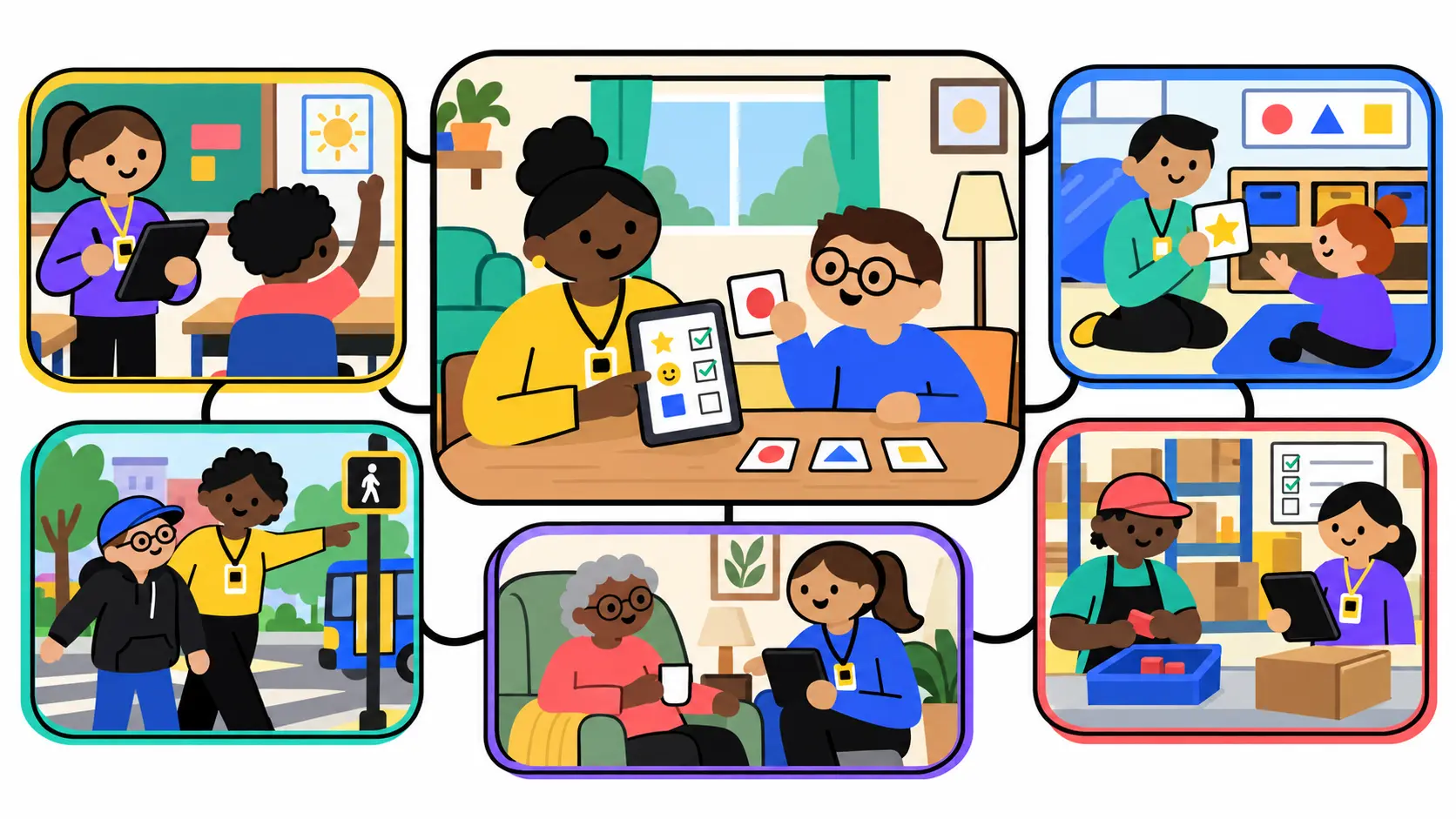
OTB Practice Studio is designed around work behavior technicians actually have to do. In its behavior-plan practice, learners begin with a simulated client scenario. They review the available plan information, identify the directions that guide the session, and then work through events that require them to use those directions.
Learners practice locating and applying information about:
- Target-behavior definitions and topography
- Antecedent and prevention strategies
- Replacement skills
- Prompting procedures
- Reinforcement plans
- Data-collection requirements
- Technician-response protocols
- Situations that should be reviewed with a supervisor
The goal is not to make a new learner feel like an expert overnight. It is to build context before fieldwork demands it.
Data collection gets harder when the session is moving
OTB Practice Studio also gives learners opportunities to practice observation and data collection while simulated events continue. The activity can require the learner to attend to the plan, recognize what happened, and record the relevant information without losing track of the larger session.
Frequency asks, “How many times did the behavior occur?” Duration asks, “How long did it last?” Other measurement systems answer different clinical questions. The concepts may sound straightforward in a lesson. Applying the right system accurately while several things are happening is the skill that requires practice.
For a deeper explanation of measurement systems, read Netflix & Data Collection: How ABA Data Methods Work.
Pair behavior-plan practice with clinical prioritization
The behavior-plan simulation pairs naturally with OTB's Emergency Room Triage: Prioritizing When Everything's Urgent course because real sessions rarely present one clean decision at a time.
A technician may need to recognize a safety concern, identify the target behavior, support a replacement response, collect data, and maintain the session routine. The challenge is not only knowing each task. It is knowing what needs attention first, what happens next, and what requires supervisor support.
Good preparation helps a technician ask: What do I do first, what do I do next, and when do I contact my supervisor?
The first time they put it together should not be in front of a client
Reading a behavior intervention plan is one skill. Implementing it under pressure is another. New technicians deserve training that connects the two.
OTB Practice Studio helps learners practice reading, observing, responding, collecting data, and documenting before those responsibilities become part of a real session. It is being incorporated into The Behavior Technician Mixtape: 40 Hours to Certification as the applied-practice component of the training experience.
Practice Studio does not replace employer-specific onboarding, client-specific training, ongoing supervision, competency-assessment requirements, or the requirements of any credentialing organization. It gives learners a stronger starting point for those experiences.
Explore the full 40-hour behavior-technician training experience and see where OTB Practice Studio fits.
Explore the Behavior Technician Mixtape →